 |
 |
 |
 |
 |
 |
 |
 |
 |
 |
 |
 |
 |
A Photographer's ViewBy Ed White (reviewer)
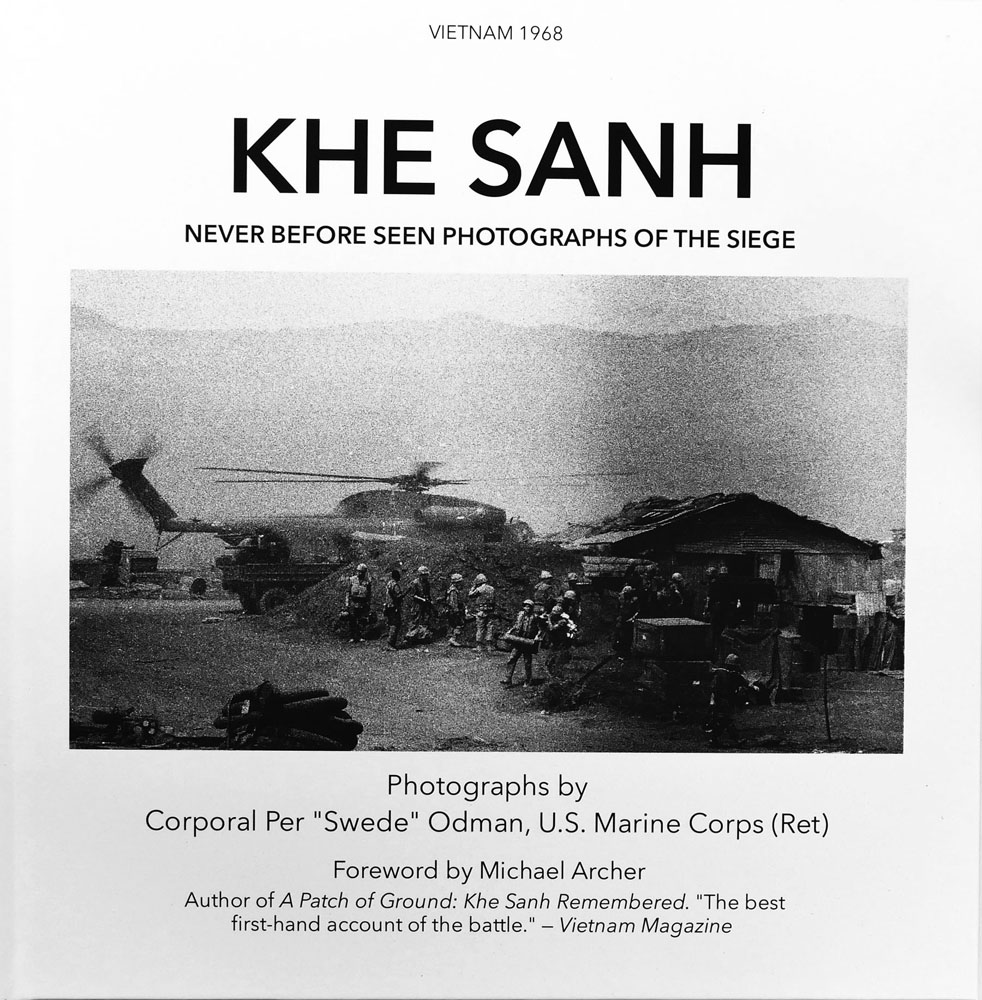
Khe Sanh: Never Before Seen Photographs of the Siege When we think of the Vietnam War and how we witnessed the war through photographs in the media, we often think: the napalm girl; the VC prisoner being shot in the head by a General; My Lai; or the helicopter on top of the CIA apartment building in Saigon. Swede Odman shows us a specific siege and time. Swede has an unusual story of how he got to Khe Sanh. He was in the Swedish Army in 1965, age 22. After seeing a film on Vietnam in the theatre, he was "eager for adventure." He got a US Green Card, flew to New York, and joined the Marine Corps. Really. After training on Paris Island, Swede shipped to Vietnam at Christmas of 1967, and to Khe Sanh. For about a month, he patrolled around the combat base, not aware of the buildup of NVA in the surrounding neighborhood. There were about 5,500 Marines and Allied soldiers on the Base. January 21, 1968 changed everything. The Tet Offensive began in South Vietnam, with the intent of the North to make Khe Sanh another Dien Bien Phu. After a 77-day siege, 274 Marines died, and 2,500 were wounded. Perhaps two to three NVA divisions surrounded the Combat Base. President Johnson committed to support the operation of defending the Base until July 9, 1968. At that time, the Marines withdrew completely. Swede's platoon was sent to Danang for guard duty. It was then that he was critically wounded and almost left for dead until a twitch was observed in his body; he was medevacked to the US. Swede's black-and-white photos show scenes of preparing sandbags, planes taking off, planes destroyed, areas destroyed, 105mm crews firing, bunkers, and destruction after incoming fire. He also photographed daily life scenes of haircuts, laughter, and the Post Exchange during the lull in bombing. Swede had accumulated skill with a camera on his prior trips to West Africa. On his way to Vietnam, in Okinawa, he picked up a Pentax SLR along with equipment and film. After filming, he sent the color slides back to his parents in Stockholm. As happened, he lost his camera and equipment in the transition. After months of recovery and living in Washington, DC, he was reunited with the film he sent his parents. And the book shows his efforts. The body of his work shows the compelling story of the siege of Khe Sanh. The core message of the daily pounding, the rhythm of surviving, and the grimness of war. Ed White is a Marine combat veteran with memberships in VVAW, VFP, and VVA. He teaches a Vietnam War course at Triton College in Illinois; his lecture, "The Lessons of Vietnam," can be viewed on C-SPAN.
|