 |
 |
 |
 |
 |
 |
 |
 |
 |
 |
 |
 |
 |
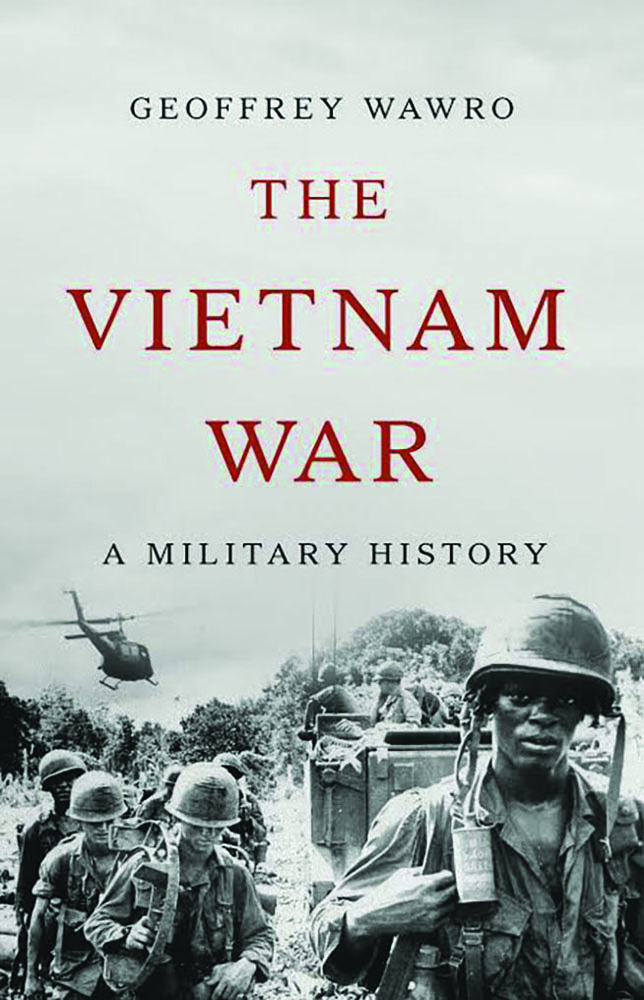
The Vietnam War: A Military HistoryBy Stephen Sossaman (reviewer)
The Vietnam War: A Military History A history of America's Vietnam War would be an extremely short book if it were not for feckless presidential careerism, stupendous Pentagon miscalculations, repeated MACV operational blunders, and nearly everyone's stubborn refusal to learn from the obvious. America's peace movement figured out the truth from the very beginning, as usual, but their understanding and good admonitions did not go unpunished, as usual. Vietnam was a war of choice, and that's the first sentence in Geoffrey Wawro's relentlessly critical The Vietnam War: A Military History. He might have added that it was a war about regime preservation, even though no one in Washington much liked the regime or its successors. This is the Vietnam War book I would first recommend to a new friend or send to an interested adult child or grandchild. And the one I would first recommend to a younger veteran of a different war. While the book's subtitle suggests a purely military focus, Wawro is at his best in illustrating the irrational disconnect between failures in the field and in diplomacy, on the one hand, and the responses to those failures, on the other. He also shows that North Vietnam's always-increasing strength in the south was well known at the time, despite officials' repeated false claims of progress. Wawro catalogs many behind-the-scenes admissions by high officials that we could not win the war, but it would have taken too much courage to do the right thing. Geoffrey Wawro does not attempt a definitive military history, but he has the chops to do so. He is the director of the Military History Center at the University of North Texas, and had access to some materials not available to earlier historians. He writes little about Navy and USAF operations, but he does praise the USMC for prioritizing civilian protection before MACV changed its mission. Some of his research was done in Vietnam. Like David Dellinger's insightful Vietnam Revisited recollections (South End Press, 1986), Wawro's history has a balanced, not romanticized, view of the NVA and NLF. Wawro depicts them in general as quick learners, able and willing to adapt to difficult circumstances, unlike most of our Army commanders. He also shows that they were at times naive and callous. Most of Washington's strategic and operational decisions were variants of doing more of what had already proven not to work. Told at one point that bombing wasn't making North Vietnam negotiate, and wasn't slowing troop movement south, McNamara's reply was to ask what then should we bomb next? His only tool was a hammer. Gen. Westmoreland publicly acknowledged our war as a war of attrition as early as April 1967, a five-alarm admission that should have woken up the press, persuaded the White House and public to get out, and motivated more service personnel to join VVAW. That was the month when Muhammad Ali refused to be inducted, articulating a deeper understanding of the war than LBJ did. Talk today of subjugating Iran through attrition shows a comparable hubris and ignorance, I think. That talk focuses on Iran's limitations, ignoring our own, in the Westmoreland tradition. To his credit, Gen. Westmoreland did not share Sec. Hegseth's macho impetuosity, but he was a slow learner, if he ever learned at all in Vietnam. He is depicted here as having, in effect, Douglas Haig-level numbskull stubbornness. LBJ and Nixon are, of course, not spared Wawro's intolerance for prioritizing career over others' lives and over the national interest. How many ambush casualties should it take to realize that the enemy only exposes itself to search and destroy patrols when it has a decisive advantage? Why would generals and politicians think that America could win a war of attrition, while the Pentagon was constantly saying that they did not have enough troops, and while the war had to be financed by borrowing? A history of our current war against Iran will likely ask similar questions. Wawro periodically reports the war's dramatic economic cost. The White House had budgeted $10.5 billion for the Vietnam War in 1967, but later discovered they would need $22 billion. The federal deficit in 1967 was $9 billion, then in 1968 it was $23 billion. The economist Michael Hudson affirms that the cost of our war, using borrowed money because of politicians' tax aversion, created 6% inflation, and so badly increased the national debt as to lead the US to abandon the gold standard, thus starting the relentless accumulation of our national debt due to what is called printing money. Our trade deficits in the late 1960s, Hudson says, were entirely due to our military spending abroad. The absolute numbers might seem quaint today. Trump's barely reported one-month 2025 operation against the Houthis apparently had $1 billion in direct costs. As I write this, the Pentagon says that Trump's Iran war directly costs about $1 billion every day. I was very moved by Wawro's account of the poorly directed November 1967 battle of Dak To, woven with his account of the confused and indecisive Washington strategy meetings that same month. Surely no field manual has ever advocated assaulting carefully prepared defensive positions up steep and unfamiliar terrain covered by thick jungle, for land not worth keeping. When the Dak To combat was happening, I was hardly aware of it, in Ft. Carson, Colorado, even though I would arrive in Vietnam the next month. After I left the Army and read widely about the war, our command decisions at Dak To seemed inexplicable. Sometimes hubris and stupidity seem like war crimes all by themselves. The most painful pages here for me covered the 9th Infantry Division's brutal Operation Speedy Express, begun two months after I left the 9th and was discharged. The scale of that brutality would not surprise anyone in VVAW. For others, the grim facts are in Wawro's The Vietnam War. Stephen Sossaman was a Fire Direction Computer in the 1/84th Artillery. He is an emeritus professor at Westfield State University in Massachusetts, now living in Burbank, California.
|