 |
 |
 |
 |
 |
 |
 |
 |
 |
 |
 |
 |
 |
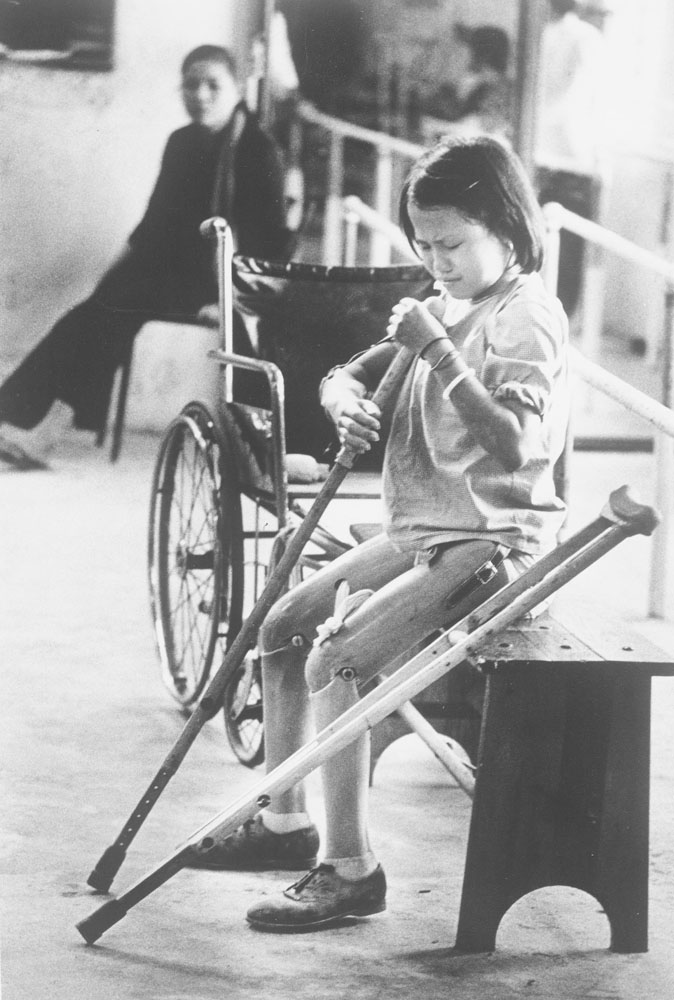
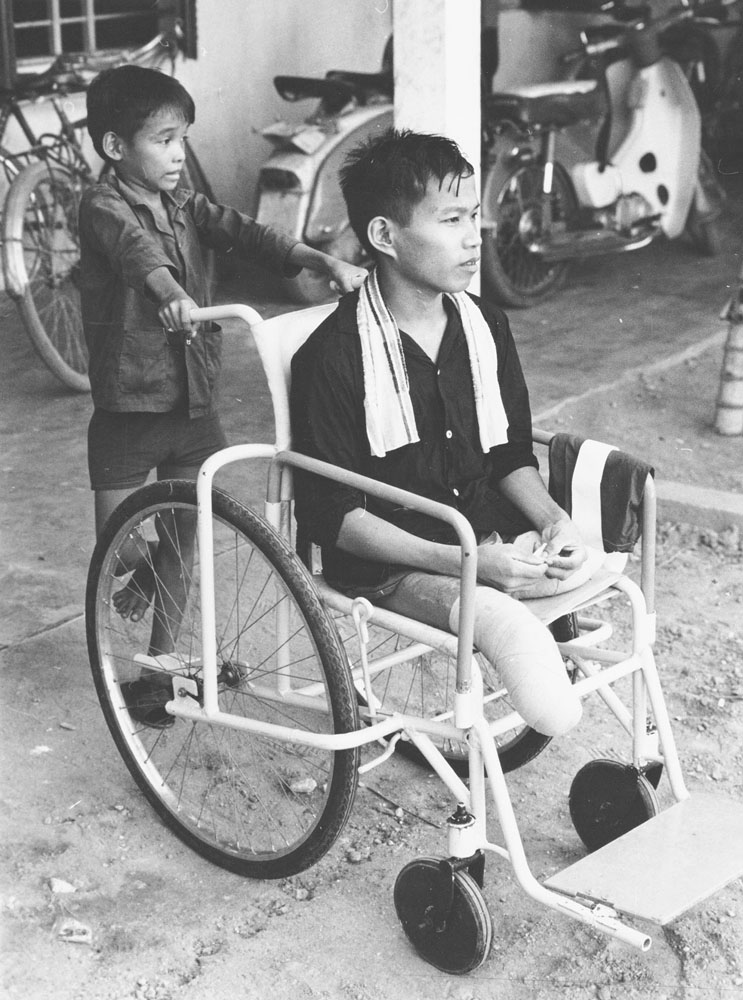
War Letters: August 1973 to March 1975By Claudia KrichI was co-director of the American Friends Service Committee’s program in Vietnam from March1973 until July 1975. We ran a civilian physical rehabilitation center in Quang Ngai, near My Lai, in central Vietnam. We also reported on the war. These are excerpts from letters I sent to my parents and brother, that have never been published.
August 23, 1973 We are now working on the hospital's prison ward, as our doctor has taken over responsibility for it. We talk to prisoners about how they got injured. A young woman in her twenties came in today. She's hemiplegic after being severely beaten during interrogation. A fifteen-year-old girl has serious kidney damage after being kicked in the stomach. And a fifteen-year-old boy has internal pains, for the same reason.
August 26, 1973 On Friday, our short-term doctor and I (as interpreter) were asked to come to the emergency room of the actual hospital to help. They had no doctors at all, and the huge shelling in Binh Son that morning and the day before had produced a lot of casualties who were beginning to arrive. We couldn't figure out what they wanted of us, so they took us in to see two patients already on the operating tables. One was hit by a mine, with fragments entering the abdomen and other parts of his body. The other man was almost too much to look at. He had been hoeing and stepped on a mine. Usually those take off legs, but somehow he must have been bent over because it blew away his chin and lower face. He just had nothing there at all. Somehow he had already lived for 24 hours and was breathing, even though he had no mouth. They wanted our generalist doctor to somehow do surgery on him, but he couldn't. I'll never forget the man's eyes desperately pleading with me for help.
September 12, 1973
November 18, 1973
December 19, 1973
February 11, 1974 Some soldiers shot an 18-year-old young woman for fun and burned 29 houses. Apparently it was revenge for the killing of some local officials. She'll only lose one foot. I told her how lucky she was, then caught myself and started laughing. She completely understood what I meant: losing a foot is almost nothing. Losing a leg or two above the knee, or being a paraplegic— that's worth feeling sad about. Looking around our Center, you just start thinking that way. Missing just a foot, she won't have much trouble walking, but she'll have trouble getting married since some men think a woman missing a limb can't get pregnant, and if the Center closes someday, she'll have trouble getting a replacement leg.
July 26, 1974
February, 1974 One very old man patient told us he was drunk and went out walking at 5 in the morning in his village. Both sides occupy his village, so a local GVN policeman on duty was quite jumpy. He saw the man and shot him with his pistol. The old man had to have one leg amputated. Well, he did break the curfew. A more typical story is of children, old people, and teenagers whose legs are blown off by ARVN mines planted helter-skelter all over rice fields and pastures. They never warn local people, and they don't deactivate the mines when they leave an area. These mines are both old, unexploded ones and brand-new ones. One man was a Special Forces soldier who was sleeping in a villager's house. He didn't know that another group of Special Forces soldiers was sleeping in a house next door. He didn't mine the area around the house he was sleeping in, but the others did. In the morning, he got up early, stepped outside, and stepped on one of their mines. He lost both legs. But being a soldier, he went to the military rehab center, not ours.
May 12, 1974
August 31, 1974
March 16, 1975 Anyway, the PRG did come in and threw two grenades into a police post 150 yards from our house, injuring several people and killing two. A few minutes later they shot into a group of Self Defense Forces, killing three, including our staff member. One PRG soldier died too, and his body was left on display by the GVN. A week ago, some PRGers shot into a police station at the other end of town. They're just showing everyone that, in fact, they can come into the city whenever they like. The ARVN are now massively bombing Ban Me Thuot to "save" it, just like Quang Tri.
March 25, 1975 There are hundreds of new foreign press people in Saigon, all waiting for The Event. The murder of Agent France Press correspondent Leandri has infuriated the press. It's pretty sure he was murdered during interrogation in the police station in Saigon, though police say he was accidentally shot while they meant to shoot his car wheels. Three shots in the side of the head. There's a 10:00 p.m. curfew, 3,000 arrests a day in Saigon, things polarizing fast. It can't last long. Local soldiers just set up a roadblock at the end of our alley, catching 17-year-old young men for the draft, and checking everyone's papers. They're also searching house to house for Communists, as if they'd ever recognize them. The GVN reports hundreds of thousands of refugees, but we don't believe it. For example, the number they give for Quang Ngai—refugees—would double the current population. It's impossible. Seems to be propaganda aimed at getting the US Congress to provide more funding.
March 31, 1975 We're told the PRG came in earlier than they planned to, simply to help by establishing some sort of government to end the looting and killing. The American Embassy, along with everyone else, has been amazed at the panic among soldiers and refugees. In Da Nang, we understand that the local civilians were not the people panicking, but rather mostly the military retreating from Hue and Quang Ngai, and refugees from Hue. Refugees ruined their own "escape" routes by overrunning the airport and causing it to shut down. The harbor was the same scene. Thousands of refugees overran boats, pushing and shoving and killing a few people. We predicted a week ago that Saigon would begin to panic just about now, and certainly with the fall of Da Nang. Our prediction is earlier than most Vietnamese, but I think it's correct. Panic is an incredible weapon. Food prices are beginning to reflect the fact that Saigon is being choked from its food sources. We are told that luxuries are cheaper, though a typewriter we priced today wasn't. Tonight I'm beginning to feel the uneasiness that eventually took us out of Quang Ngai. Foreigners: targets. I think if the process were slower, there would be fewer refugees, because the panicking people might be able to stop and realize that the retaliation they fear—the bombing and artillery of the GVN on its own territory when it's taken over—is becoming less and less of a danger as they retreat farther and farther South. And North. The situation in Saigon is the most important one, since it will be the final stage. There are different views on what could and should happen, but I have yet to meet anyone who wants to salvage Thieu and his friends. If Thieu manages to stick it out to the end, the last fight will surely be bloody, not so much because anyone will fight for Thieu but because of panic, like Da Nang but worse. What people say about Thieu is that if he tries to leave, he'll be killed, and if he stays, he'll also be killed. Second, Thieu may resign or be killed. Then the liberal opposition may take over, strengthen the government, include the Third Force people, and honestly implement the Peace Agreement and help bring peace. From what we've heard, this solution is fine with the PRG, though it's not the total victory of the first possibility. It's presumably a much less bloody last stand, perhaps even bloodless. Third, Thieu may resign or be killed, and then a rightist coup may take over. This would be difficult in various ways. One, it might be just the same and create further confusion and panic. If it's a slight improvement, the PRG may lose some of the energy being generated by fast victories so far, by losing their war enemy, Thieu. Or, a new regime might get support from the United States, which might resume funding. No one doubts that this is the end of the Thieu regime. People only wonder how it will go and if they'll survive it. The race is on. Can the opposition Third Force groups get rid of Thieu before the whole situation falls apart? Marshall Ky seems to be after the job. General Minh is also most interested. General Minh, according to one source, would hope to strengthen what's left of the military, increase its morale (how?), and then negotiate with the PRG, keeping separate territories but giving everyone the freedom to travel. I think the PRG would like to see this happen, since it would, among other things, give them greater protection against attacks from the US. But the people's panic may not allow such a solution. To be continued in the Spring 2027 issue of The Veteran. Claudia Krich is the author of the book "Those Who Stayed: A Vietnam Diary," which was released in April, 2025. She directed a medical relief program based in Quang Ngai, Vietnam from 1973 to 1975.
|